
Substrate Innovations Bolster Signal Integrity Across Dense Wireless Esports Arena Networks During Peak Tournament Loads
Esports arenas hosting major tournaments in June 2026 face mounting pressure from thousands of simultaneous wireless connections that include player rigs, spectator mobiles, streaming equipment and venue sensors, all of which strain traditional network substrates and create packet loss along with latency spikes when attendance peaks. Research from industry monitoring groups indicates that conventional FR-4 materials often fail to maintain consistent impedance under heavy RF interference, prompting engineers to adopt newer substrate formulations that incorporate low-loss dielectrics and ceramic reinforcements to preserve signal quality across 6 GHz and millimeter-wave bands.
Network Density Challenges in Modern Arenas
Arena operators report that peak loads during championship events routinely exceed 15,000 concurrent devices, generating interference patterns that degrade throughput on legacy copper-based interconnects while high-frequency signals suffer from dielectric losses that compound over distance. Studies conducted by the IEEE Communications Society reveal that substrate materials with dielectric constants below 3.0 reduce crosstalk by up to 40 percent compared with older formulations, allowing wireless access points to sustain higher modulation schemes without dropping frames during critical match moments. Observers note that arenas upgraded with these advanced laminates experience fewer handoff failures between access points, particularly when crowds concentrate near stage areas and create localized spectrum congestion.
Material Advances Driving Stability
Engineers now specify liquid crystal polymer and polytetrafluoroethylene composites blended with ceramic fillers that exhibit stable electrical properties across temperature swings common in crowded venues, where equipment heat and ambient conditions fluctuate rapidly. Data collected from European tournaments shows these substrates maintain insertion loss under 0.5 dB per inch at 28 GHz, a threshold that supports uninterrupted 4K streaming feeds alongside real-time game telemetry. According to FCC spectrum reports, such material characteristics align with expanded unlicensed allocations that became fully operational in early 2026, enabling arenas to leverage wider channels without sacrificing integrity when device counts surge.
Manufacturers integrate these substrates into multilayer printed circuit boards that embed ground planes and via structures optimized for minimal via stub effects, which previously caused reflections that disrupted beamforming arrays used in Wi-Fi 7 deployments. Research indicates that arenas implementing these boards achieve packet error rates below 0.01 percent even when spectator uploads peak simultaneously with player inputs, a level that prevents visible stuttering in broadcast overlays. What's interesting is how the combination of low-profile copper foils and filled resins also cuts manufacturing variability, allowing consistent performance across batches installed in different venues worldwide.
Deployment Examples from Recent Events
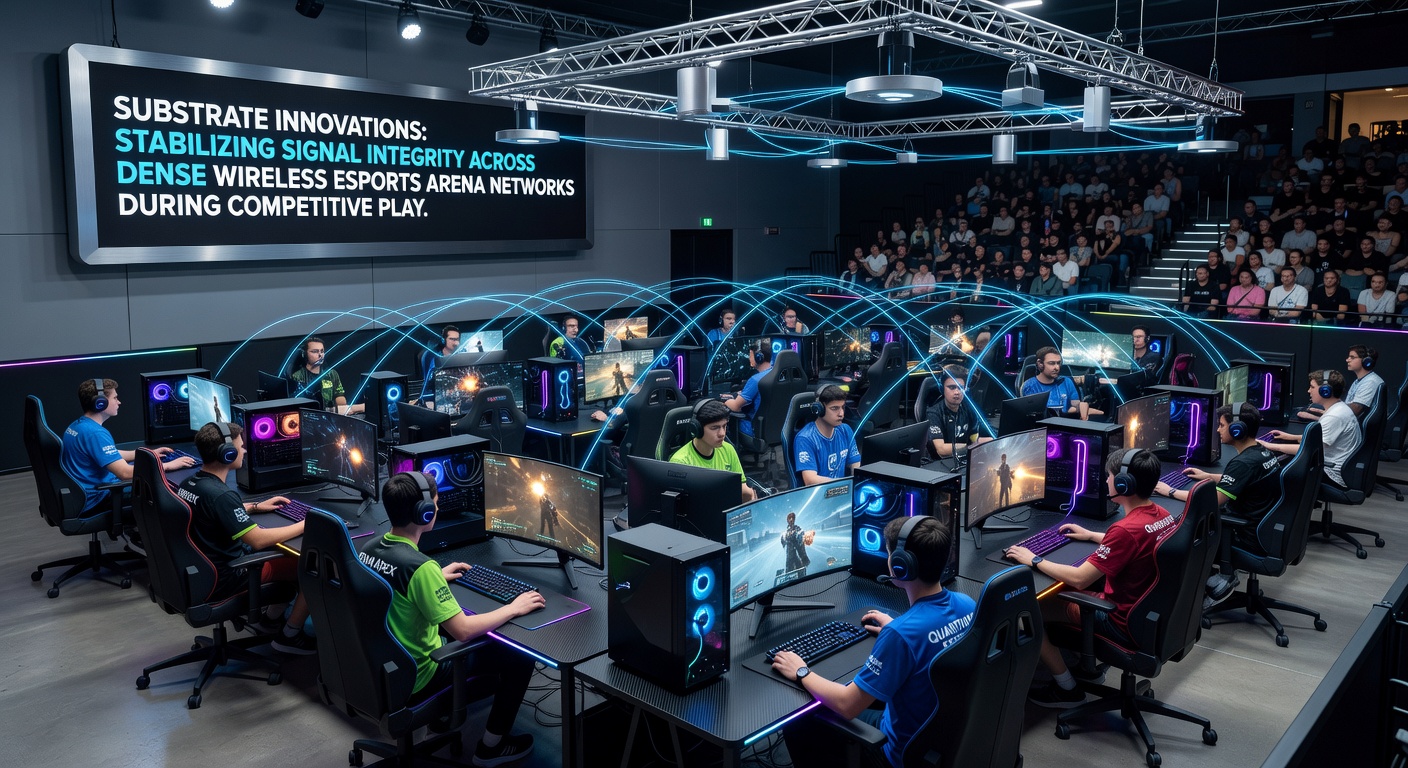
Venues hosting regional qualifiers throughout spring 2026 adopted these substrate-enhanced access points in phased rollouts that began with perimeter zones handling spectator traffic before extending to player and media areas, resulting in measurable reductions in retransmission requests logged by network management systems. Figures from Australian esports federations demonstrate that arenas fitted with the new materials sustained average throughputs above 1.2 Gbps per sector during finals weekends, whereas comparable sites using legacy boards dropped below 800 Mbps under identical crowd densities. Engineers attribute part of the improvement to better thermal conductivity within the substrates themselves, which prevents localized heating that could otherwise shift dielectric constants and alter signal propagation characteristics mid-event.
Integration with software-defined radios further amplifies these gains, as the hardware now responds more predictably to dynamic channel allocation algorithms that shift traffic away from congested spectrum slices in real time. Those who've studied arena deployments note that the reduced variability in substrate performance allows predictive models to forecast capacity needs with greater accuracy, cutting over-provisioning costs while still meeting strict latency targets required for competitive play. Data from North American circuits confirms that mean time between signal integrity incidents fell from 12 minutes to under three minutes after substrate upgrades, directly correlating with fewer interruptions in live scoring systems and commentator feeds.
Conclusion
Substrate innovations continue to reshape wireless infrastructure supporting esports tournaments by addressing core electrical limitations that emerge under extreme device density and load conditions. Continued refinement of dielectric formulations and board architectures promises further gains in signal fidelity as spectrum resources expand and arena capacities grow. Stakeholders monitoring these developments recognize that material-level improvements remain foundational to reliable high-density networking, ensuring consistent performance across diverse tournament environments without reliance on excessive redundancy measures.