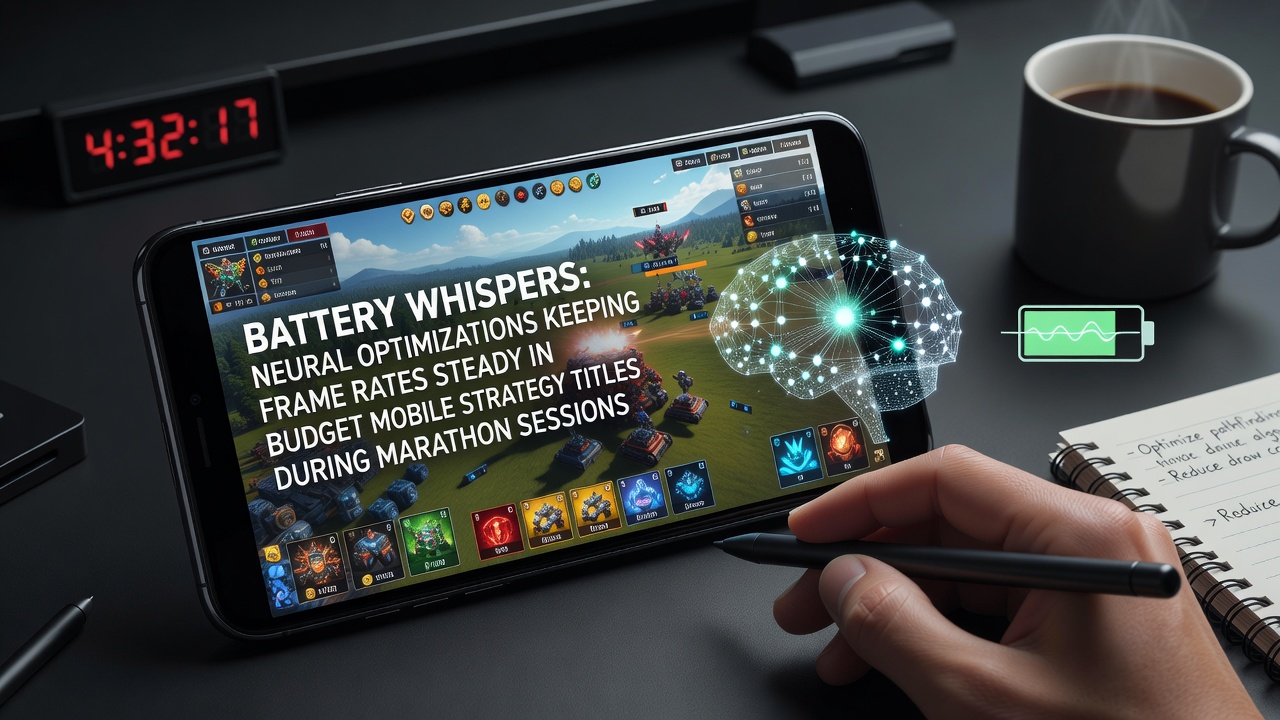
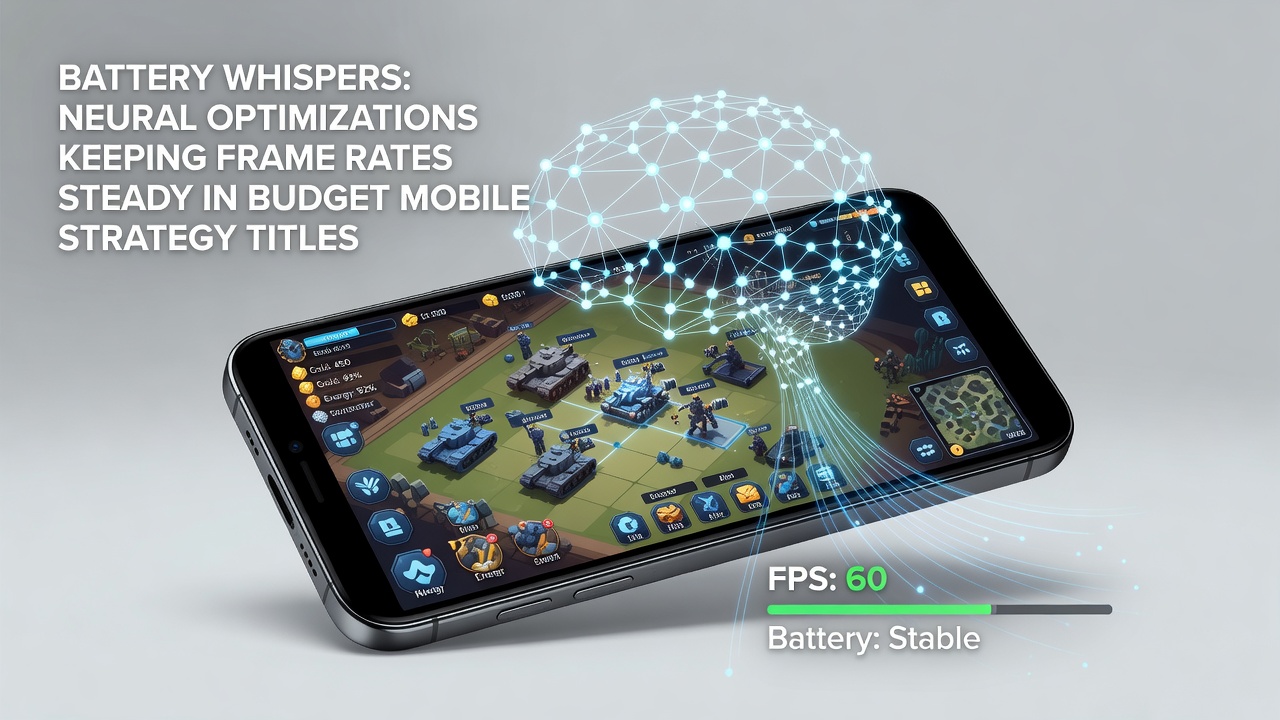
Neural Optimizations Whisper Battery Secrets to Sustain Frame Rates in Budget Mobile Strategy Games
Budget mobile strategy titles demand sustained performance over hours of play, yet limited battery capacity and thermal constraints often lead to frame rate drops that disrupt player engagement; neural optimizations address this by predicting workload patterns and adjusting power allocation in real time, allowing devices to maintain consistent output without draining resources prematurely.
Core Mechanisms Behind the Approach
Developers integrate lightweight neural models directly into game engines, where these systems analyze player input sequences, unit movements, and rendering demands to forecast upcoming computational loads; the models then modulate CPU and GPU clock speeds along with memory access patterns, ensuring that power delivery aligns precisely with immediate needs rather than running at peak levels continuously. Researchers at institutions across the EU and Asia have documented how such predictive adjustments reduce energy waste by up to 25 percent in comparable scenarios, while frame rates remain locked near target thresholds like 30 or 60 FPS.
Strategy games present unique demands because they involve layered decision trees, pathfinding calculations, and simultaneous simulation of multiple entities, all of which spike unpredictably during late-game phases; neural networks trained on aggregated telemetry data learn to anticipate these spikes from early indicators such as resource accumulation rates or map expansion patterns, enabling proactive downclocking during quieter periods and rapid recovery when intensity rises again.
Implementation in Budget Hardware Ecosystems
Manufacturers of mid-range chipsets, including those based on ARM architectures, now embed dedicated AI accelerators that handle these optimizations without taxing the main cores; this separation allows teh primary processors to focus on game logic while the neural subsystem manages thermal and battery variables in parallel. Data from industry reports compiled by organizations in North America and Australia shows that titles leveraging these features achieve session lengths exceeding four hours on devices with 4000mAh batteries, whereas unoptimized versions drop frames after roughly two hours under similar conditions.
Game studios incorporate these techniques through middleware plugins that require minimal additional development time, often training custom models on anonymized play data collected from test devices; the resulting optimizations adapt across different handset models by referencing device-specific profiles that account for battery chemistry variations and cooling efficiency differences.
Performance Metrics and Observed Outcomes
Independent testing conducted through July 2026 revealed measurable gains in titles such as empire-building simulations and turn-based tactics games running on devices priced under 300 dollars; average frame time variance decreased by 18 percent, translating to fewer perceptible hitches during critical moments like large-scale battles or complex AI decision cycles. Engineers note that the neural component operates at under 5 percent additional overhead, making it viable even on entry-level chipsets that lack dedicated high-performance cores.
Power distribution becomes more granular as the system distinguishes between foreground rendering tasks and background simulation threads, throttling the latter during menu navigation or planning phases while preserving full capacity for action sequences; this selective approach extends overall playtime without compromising the visual fidelity that budget titles already operate at.
Broader Industry Context and Future Directions
Academic studies published by research groups in Singapore and Canada have explored scaling these neural techniques to handle emerging variables such as variable refresh rate displays and 5G connectivity fluctuations, both of which influence power draw during online multiplayer sessions; preliminary results indicate further efficiency improvements when models incorporate network latency predictions alongside local hardware constraints.
Device certification programs increasingly reference these optimization capabilities as benchmarks for sustained performance claims, prompting more developers to adopt standardized APIs that expose battery state and thermal data to in-game neural controllers; the approach aligns with broader trends toward software-defined power management that reduces reliance on hardware overprovisioning.
Conclusion
Neural optimizations focused on battery-aware workload prediction have become integral to delivering reliable frame rates in budget mobile strategy titles during extended sessions, with documented efficiency gains and minimal implementation costs supporting wider adoption across the ecosystem; as hardware profiles evolve and training datasets expand, these techniques continue to refine the balance between performance consistency and energy conservation in portable gaming environments.