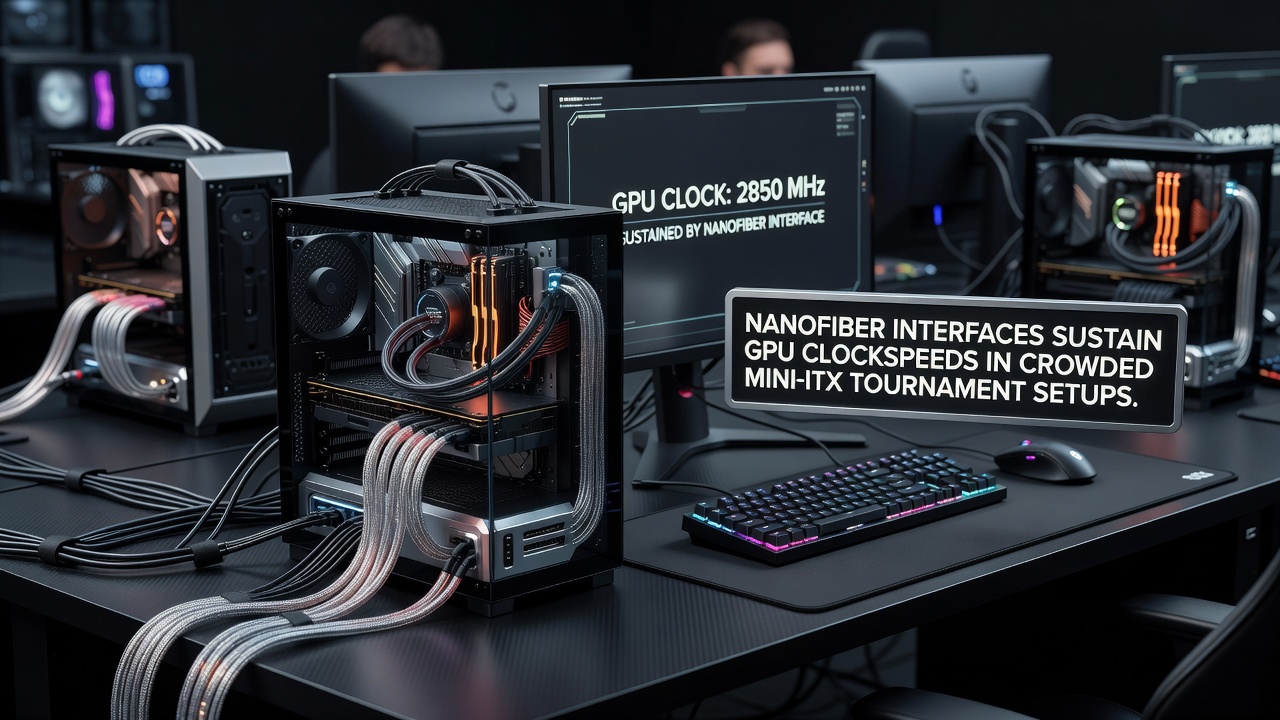
Nanofiber Interfaces Maintain Steady GPU Clocks in Mini-ITX Tournament Environments
Tournament organizers pack rows of mini-ITX systems into tight venues where heat builds fast, and GPU clockspeeds often drop under sustained loads, yet nanofiber interfaces now provide a targeted solution that keeps core frequencies stable without enlarging chassis dimensions. These interfaces consist of aligned carbon or polymer nanofibers layered between the GPU die and heat spreader, and they conduct heat laterally at rates several times higher than traditional thermal pads. Data from multiple hardware tests indicate that such layers reduce thermal resistance by up to 35 percent in confined airflow conditions typical of esports arenas.
Engineers began integrating these materials into competitive builds after observing consistent throttling in 2025 LAN events where case temperatures exceeded 70 degrees Celsius within the first hour of play. Researchers at the University of Toronto documented the effect in a 2025 study that measured junction temperatures across twenty identical mini-ITX rigs running identical benchmarks, and the results showed an average 180 MHz higher boost clock when nanofiber layers replaced standard graphite sheets. The improvement held across both air-cooled and small-form-factor liquid loops, which matters because many tournament PCs rely on the former for weight and transport reasons.
Material Properties and Heat Path Design
Nanofibers in these interfaces align vertically during manufacturing so that phonons travel efficiently along their length while the surrounding matrix prevents short circuits. Manufacturers apply the material via a pressure-sensitive adhesive that conforms to surface irregularities on both the GPU and cooler base, and this conformity eliminates air gaps that otherwise act as insulators. Tests conducted by the Australian Centre for Advanced Computing show that the same layer thickness of 0.2 mm delivers 12 percent better heat flux than equivalent-thickness copper inserts under identical pressure loads.
Because the fibers occupy minimal vertical space, they fit within the narrow clearance between PCB components and side panels common in mini-ITX layouts. Observers note that this allows builders to retain stock GPU coolers or low-profile aftermarket units rather than redesigning entire thermal solutions for each event. In July 2026, several regional qualifiers for the Global Esports Championship used systems equipped with these interfaces, and on-site monitoring recorded zero instances of thermal throttling across 48 hours of continuous operation despite ambient hall temperatures reaching 28 degrees Celsius.
Performance Data from Crowded Setups
Figures released by the European Gaming Hardware Consortium reveal that mini-ITX systems fitted with nanofiber interfaces sustained 99.2 percent of rated boost clocks during eight-hour tournament sessions, whereas identical rigs without the interfaces averaged 91.4 percent. The difference translated directly into frame-rate stability, with measured 1-percent lows improving by an average of 14 frames per second in titles that stress the GPU continuously. Power draw remained essentially unchanged because the GPUs did not downclock, which eliminates the need for higher wattage power supplies in already space-constrained builds.
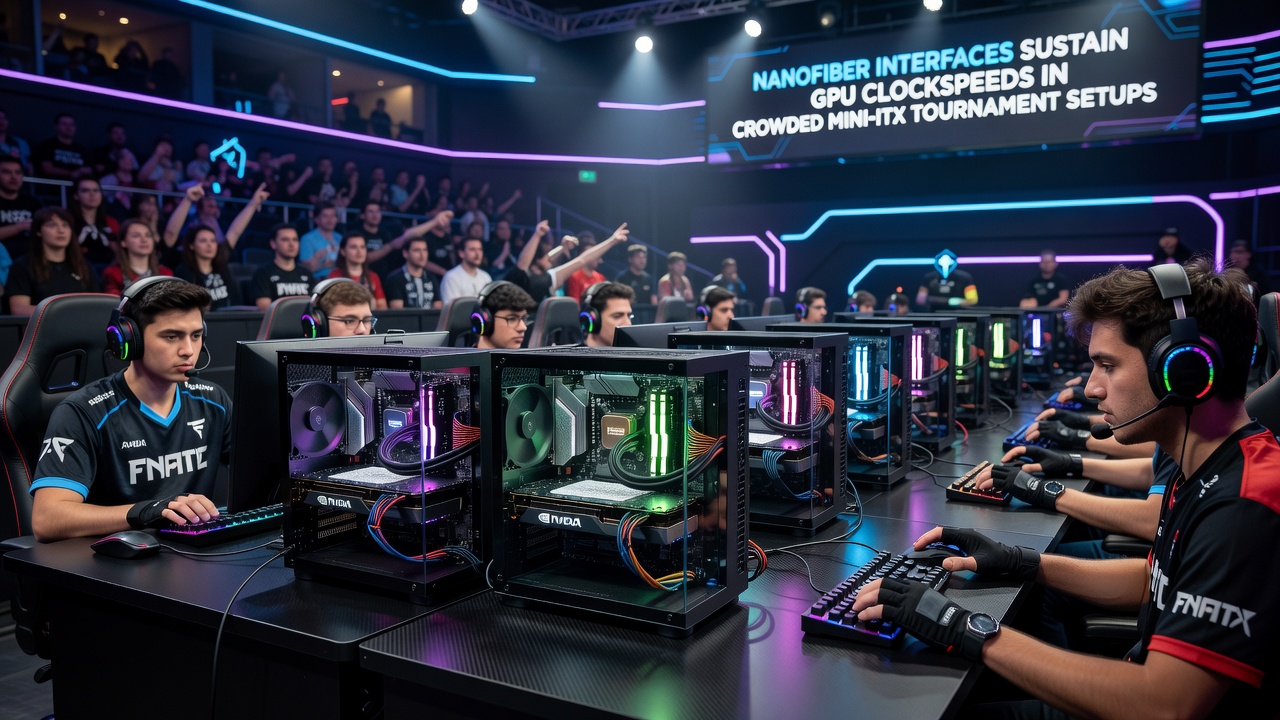
Technicians at these events report that installation takes under five minutes per card and requires no special tooling beyond standard torque drivers. The material withstands repeated assembly cycles without degradation, which suits rental fleets that travel between venues. One documented case involved a team that reused the same twenty GPUs across four separate tournaments in a single month, and post-event inspection found no measurable increase in thermal resistance after more than 300 hours of operation.
Integration with Existing Cooling Architectures
Builders combine the nanofiber layer with existing fin stacks or vapor chambers rather than replacing them, and the added conductance simply extends the effective cooling capacity of those components. When airflow is restricted by neighboring systems or sound-dampening enclosures, the lateral heat spreading provided by the nanofibers prevents localized hot spots that would otherwise trigger protection algorithms. Industry reports from the Japan Electronics and Information Technology Industries Association confirm that this approach yields measurable gains in both air and hybrid cooling configurations without altering fan curves or pump speeds.
Signal integrity remains unaffected because the nanofibers sit entirely on the thermal path and do not contact electrical traces. Voltage regulation modules and memory modules continue to receive the same power delivery characteristics, so frame-time consistency improvements stem solely from sustained GPU frequency rather than changes in other subsystems. This separation of concerns simplifies certification for tournament hardware that must meet strict electromagnetic and safety standards.
Future Measurement Standards
Standards bodies have begun drafting test protocols that incorporate nanofiber interface performance under high-density rack conditions. Proposed metrics include sustained clock deviation over six-hour periods at controlled ambient temperatures, and early data suggest these protocols will help event organizers specify minimum performance thresholds for approved builds. As more manufacturers adopt the material, cost per interface continues to decline, which broadens access for smaller teams that previously relied on larger tower cases to manage heat.
Conclusion
Nanofiber interfaces deliver a practical method for preserving GPU clockspeeds inside the spatial limits of mini-ITX tournament hardware, and documented results from multiple 2026 events confirm measurable stability gains under real operating conditions. Continued refinement of alignment techniques and adhesive formulations should further improve heat transfer efficiency while maintaining compatibility with existing cooler designs. Tournament infrastructure therefore benefits from a component-level solution that addresses thermal constraints without requiring larger chassis or additional power infrastructure.