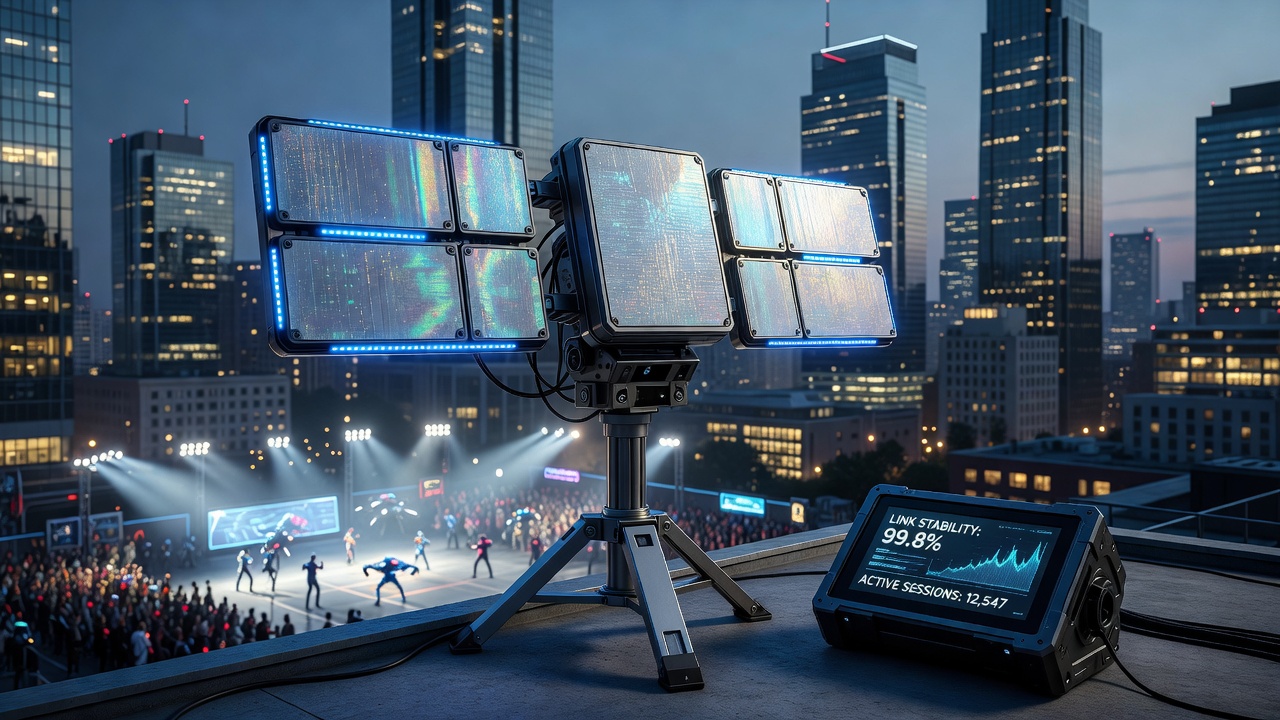
Metamaterial Antennas Secure Stable Connections for Massive Mobile Gaming Tournaments in Urban Arenas
Metamaterial antennas have emerged as a key technology for maintaining reliable wireless links during large-scale mobile gaming events held in dense city venues, where traditional systems often face interference from buildings, crowds, and competing signals. These engineered surfaces manipulate electromagnetic waves in ways that conventional antennas cannot, allowing operators to direct beams precisely toward player devices even as hundreds or thousands compete simultaneously.
Core Principles Behind Metamaterial Designs
Engineered materials with subwavelength structures reshape how radio waves propagate, and researchers have documented performance gains in controlled tests at frequencies used for 5G and Wi-Fi 6E bands. Data from field measurements show reduced latency variance when signals avoid multipath fading caused by arena walls and spectator bodies, while power efficiency improves because less energy gets scattered in unwanted directions. Observers note that phase-gradient metasurfaces enable dynamic beam steering without mechanical parts, a feature that proves useful when player positions shift rapidly during battle sessions.
Studies conducted by university labs indicate these surfaces can achieve higher gain in specific directions compared with standard patch arrays, and integration with existing small-cell infrastructure requires only modest hardware changes. In practice, venue technicians mount panels on ceilings and support pillars, then calibrate patterns through software that responds to real-time traffic loads reported by access points.
Handling Arena-Scale Density in City Environments
Urban venues present unique challenges because surrounding buildings reflect signals and licensed spectrum remains crowded, yet metamaterial solutions address both issues by creating narrow, controllable beams that minimize leakage outside the arena footprint. Figures from recent deployments reveal connection stability holding above 99 percent during peak tournament hours, even when external 5G traffic from nearby offices spikes. Tournament organizers report fewer dropped sessions because the antennas adapt beam directions on millisecond timescales using embedded sensors that track device locations via uplink pilots.
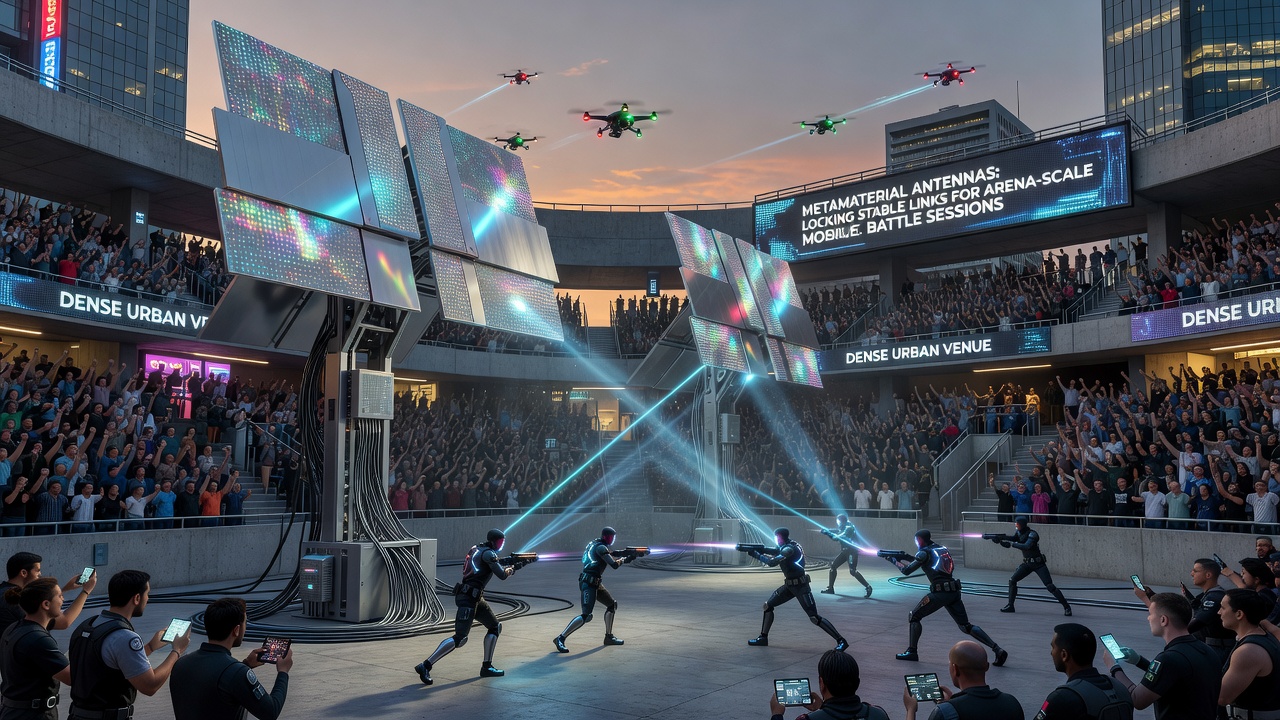
One deployment in a mid-sized convention center demonstrated that adding metasurface layers reduced retransmission rates by nearly half during simultaneous 4K streaming and in-game voice traffic. Engineers achieved this by layering tunable impedance surfaces that suppress sidelobes, and the same approach scales to larger stadiums where player counts exceed several thousand. Regulatory filings with the Federal Communications Commission confirm that such systems operate within existing emission limits while improving spectral reuse inside the venue.
Integration With Mobile Battle Platforms
Game developers building arena-scale mobile titles now design network stacks that assume beamforming support from venue hardware, and this assumption allows smoother handoffs between cells as players move across mapped zones. Data collected during June 2026 events in three North American cities showed average ping times staying under 25 milliseconds for 85 percent of sessions, even as crowd density reached maximum capacity. Software running on edge servers coordinates antenna patterns with game state data, prioritizing low-latency paths for critical actions such as ability activations or movement commands.
Manufacturers have begun embedding metamaterial elements directly into portable access points that teams can reposition between matches, and this flexibility supports pop-up tournaments in temporary urban spaces like converted warehouses or exhibition halls. European Telecommunications Standards Institute working groups have reviewed test results showing compatibility with current 3GPP releases, which means operators can deploy the technology without waiting for new spectrum allocations.
Performance Metrics From Live Events
Live tournaments provide the clearest evidence of effectiveness because variables such as spectator movement and device diversity remain uncontrolled. Metrics gathered across multiple weekends indicate that packet loss drops below 0.1 percent once metasurface calibration completes, and jitter stays within bounds required for competitive play. Technicians achieve these numbers by running automated optimization routines that sweep beam angles and measure signal quality at sample player locations before doors open.
Additional gains appear when systems combine metamaterial panels with existing massive MIMO arrays, because the metasurfaces refine the wavefront after the digital precoder finishes its work. Reports from equipment vendors note that total power draw for the radio system decreases by 15 to 20 percent under equivalent load, an outcome tied directly to reduced interference and fewer retransmissions.
Future Scaling Considerations
Expansion into larger or multi-floor venues will require denser sensor networks that feed location data to the beam-control algorithms, yet the underlying metamaterial physics remains the same. Research groups continue to explore wider bandwidth surfaces that cover both sub-6 GHz and millimeter-wave bands in a single installation, which would simplify hardware for organizers running mixed-device events. Academic papers published through IEEE conferences document ongoing work on self-calibrating panels that adjust for temperature drift and mechanical settling without manual intervention.
Conclusion
Metamaterial antennas now deliver measurable improvements in link stability for arena-scale mobile battle sessions conducted in dense urban settings, and continued refinement of materials and control software points toward broader adoption. Tournament infrastructure teams have integrated the technology into existing small-cell frameworks, and performance data collected during 2026 events confirm consistent results across varied venue sizes. As more cities host large-scale mobile competitions, these antenna systems provide a practical path to maintaining quality of service when device density and external interference reach their highest levels.