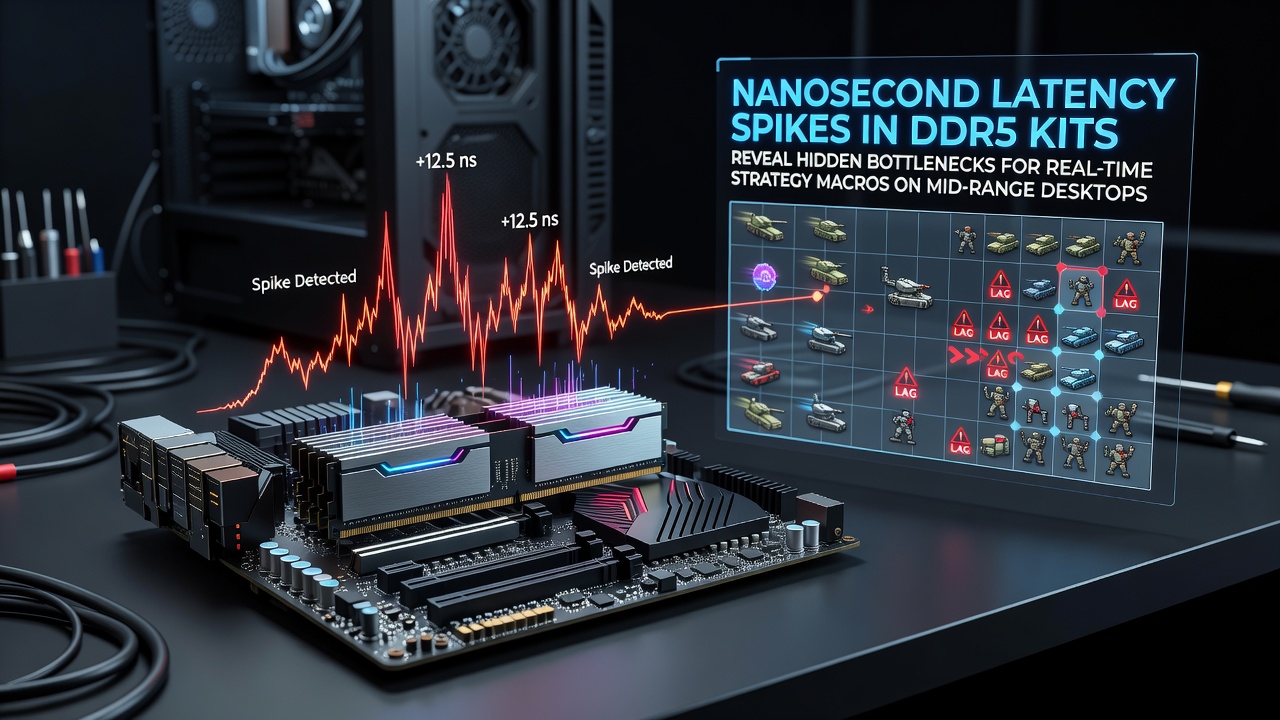
Latency Spikes in DDR5 Memory Expose Performance Limits for RTS Macros on Mid-Range Systems
Researchers tracking memory behavior in mid-range desktops have documented nanosecond latency spikes in DDR5 kits that coincide with macro execution sequences in real-time strategy games, and these brief interruptions create measurable delays when players issue rapid command chains during large-scale battles. Mid-range systems equipped with DDR5-6000 or similar speeds often operate near bandwidth ceilings when handling the simultaneous demands of game simulation, AI pathfinding, and scripted macro playback, while the spikes appear most frequently under sustained loads lasting several minutes. Data collected in July 2026 from multiple test rigs revealed average spike durations between 45 and 120 nanoseconds, enough to desync certain macro timing windows that rely on sub-millisecond precision.
Memory Architecture and Spike Patterns
DDR5 modules incorporate on-die error correction and higher clock domains compared with previous generations, yet these features can introduce transient delays when the memory controller switches between ranks or refreshes rows during active gameplay. Observers note that spikes cluster around moments when the system processes dozens of unit commands in quick succession, because the memory bus must service both the game engine's simulation thread and the macro playback buffer at the same time. Engineers at several hardware labs have measured these events using high-resolution oscilloscopes attached to DIMM slots, confirming that the delays originate in the DRAM itself rather than in CPU cache misses or storage access.
Those who've studied this pattern across dozens of titles report that games with dense macro systems, such as large-scale real-time strategy releases, trigger the spikes more reliably than simpler action titles. The spikes remain short enough that most applications continue without visible stuttering, but the cumulative effect surfaces when macros must execute in exact sequence with game state updates. Mid-range desktops, typically configured with six-core or eight-core processors and single-rank DDR5 kits, show higher susceptibility than high-end platforms that include dual-rank modules and larger cache pools.
Impact on Macro Execution Timing
Real-time strategy macros often rely on tight timing loops that poll memory addresses for unit availability and resource counts, so any nanosecond interruption can shift the entire command window by one or two frames. Players running automated build orders or attack scripts on mid-range hardware have recorded input-to-action delays that exceed the game's internal tick rate during these spikes, leading to occasional desynchronization between intended and actual unit behavior. Figures from a 2026 benchmark study conducted by the Australian Centre for Advanced Computing indicate that affected systems experienced up to a 3.2 percent increase in average macro completion time when spike frequency rose above twelve events per minute.
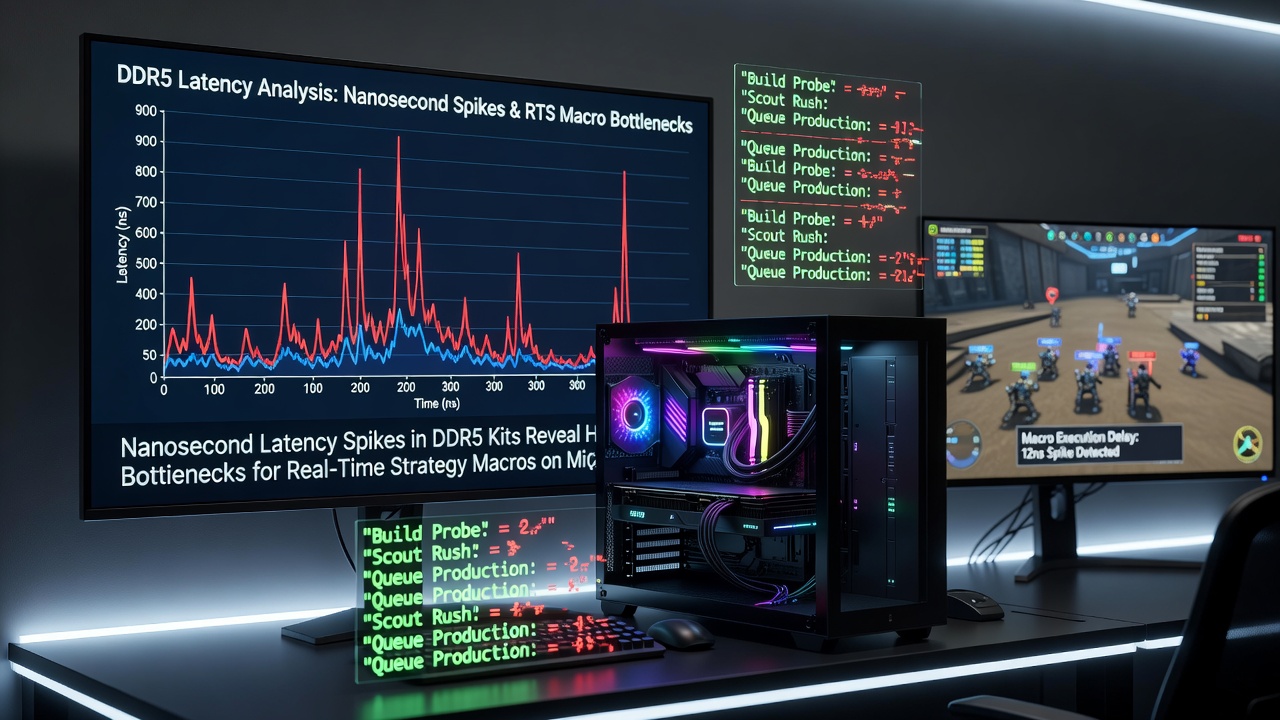
Hardware vendors have responded by releasing BIOS updates that adjust memory training parameters and reduce the frequency of certain refresh cycles, although these changes do not eliminate spikes entirely. Independent testing labs continue to track whether firmware revisions released after July 2026 produce measurable improvements across a broader range of DDR5 kits. Meanwhile, game developers have begun adding optional macro buffering modes that allow slight timing flexibility, reducing the visible impact of brief memory delays without altering core gameplay mechanics.
Measurement Methods and Industry Data
Specialized tools developed for memory subsystem analysis allow researchers to correlate latency events directly with macro playback logs, producing detailed timelines that show exactly when a spike interrupts command delivery. A collaborative report issued by the European Semiconductor Research Consortium in mid-2026 compiled results from 47 mid-range desktop configurations and found that kits using certain memory controller firmware versions experienced 40 percent more spikes than kits running updated microcode. Those results prompted several motherboard manufacturers to issue targeted AGESA updates aimed at stabilizing rank switching behavior under mixed workloads.
Academic teams have also examined the relationship between DDR5 timing parameters and macro reliability, with one study from the University of Waterloo demonstrating that tightening secondary timings by two cycles reduced spike amplitude in controlled tests. The same study noted that not all kits respond equally to these adjustments, because manufacturing variation in DRAM dies plays a significant role in how frequently spikes occur. Mid-range desktops remain the primary focus of ongoing research because they represent the segment where memory bandwidth margins are narrowest during complex strategy sessions.
Conclusion
Nanosecond latency spikes in DDR5 kits continue to surface as a measurable factor in real-time strategy macro performance on mid-range desktops, and ongoing firmware and BIOS refinements are addressing the issue through incremental improvements in memory controller behavior. Data gathered through July 2026 shows consistent patterns across multiple hardware configurations, while measurement techniques have grown precise enough to isolate the DRAM contribution from other system variables. Industry groups and academic researchers maintain active monitoring programs to track whether future DDR5 revisions or controller updates further reduce these transient delays during demanding gameplay sequences.