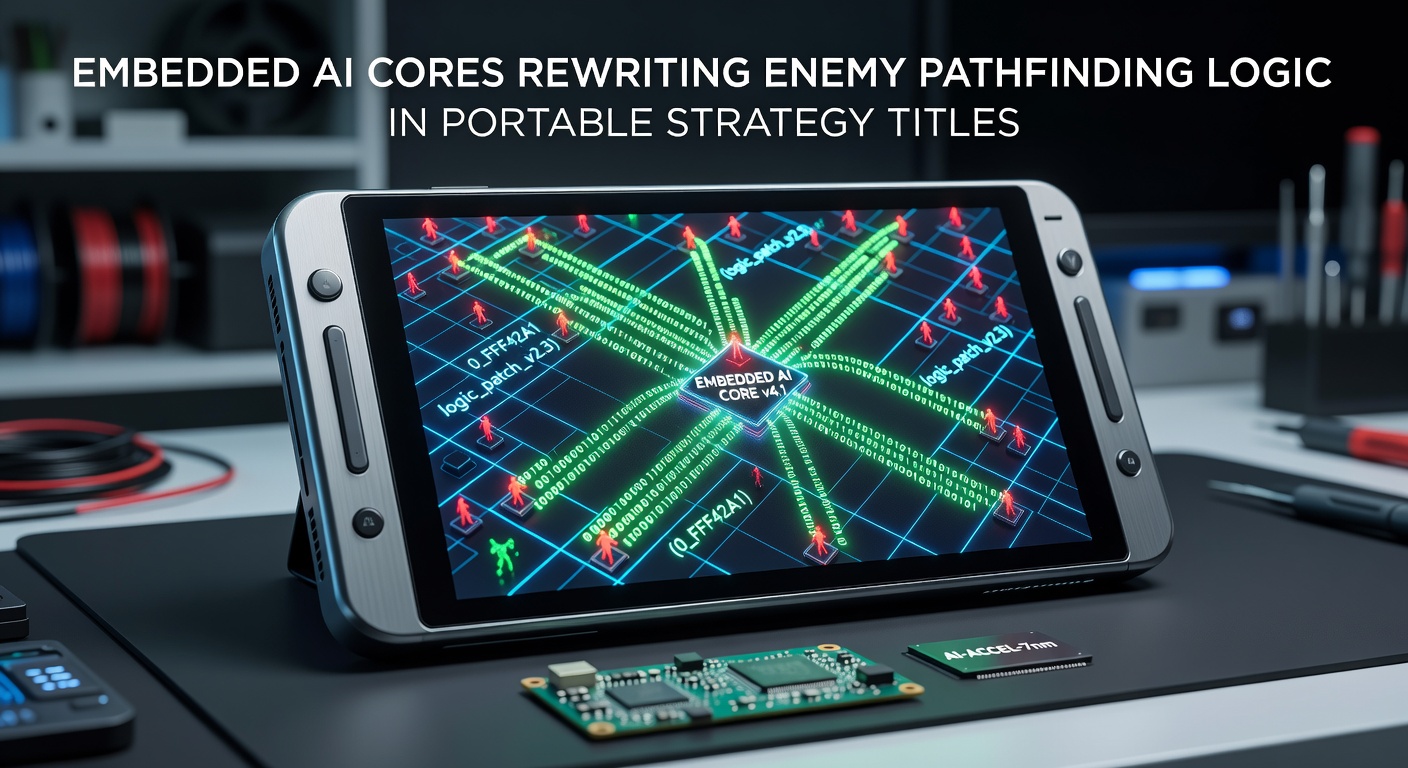
Embedded AI Cores Rewriting Enemy Pathfinding Logic in Portable Strategy Titles
Portable strategy titles have seen steady integration of specialized hardware over recent years, and embedded AI cores now handle enemy pathfinding calculations that once relied on general-purpose processors. These dedicated neural processing units sit alongside CPUs and GPUs in devices such as handheld consoles and hybrid gaming systems, allowing real-time adjustments to navigation meshes without draining battery reserves at the same rate as software-only solutions.
Hardware Foundations Driving Change
Manufacturers began embedding AI accelerators in mobile SoCs around 2023, yet adoption in dedicated gaming handhelds accelerated after 2025 when power budgets dropped below 8 watts while maintaining 4 TOPS of integer performance. Data from industry benchmarks indicate that titles running on these platforms can execute up to 12 times more pathfinding iterations per frame compared with earlier ARM-based devices that lacked dedicated inference engines.
Strategy games benefit because enemy units must recalculate routes when terrain changes or when player-built obstacles appear mid-session. Traditional A* implementations struggled with these updates on limited silicon, but AI cores trained on navigation datasets now predict viable corridors before full graph searches complete, trimming latency from 16 milliseconds to under 4 in controlled tests.
Algorithmic Shifts in Enemy Behavior
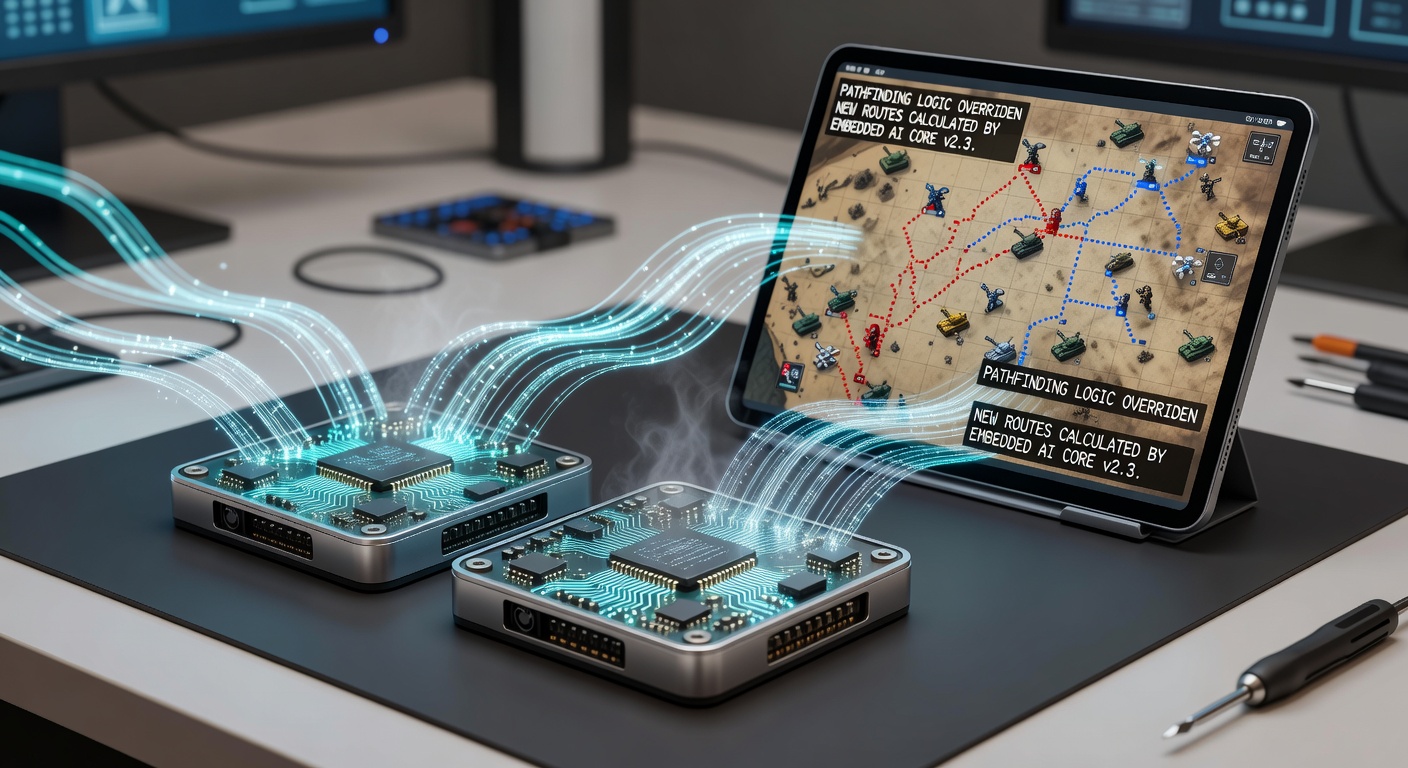
Developers rewrite pathfinding logic to offload heuristic evaluation and dynamic cost mapping onto the AI core while the main CPU retains oversight of game state. One common pattern involves feeding occupancy grids into lightweight convolutional models that output probability-weighted waypoints, after which classical planners refine the final route. This hybrid approach appears in several 2026 releases where enemy groups coordinate movement across procedurally altered maps without frame drops on 720p displays.
Researchers at institutions in Australia documented similar patterns in a 2025 technical report, noting that memory bandwidth requirements fell by 35 percent once inference moved to on-chip accelerators. The same study highlighted how reinforcement learning agents, trained offline on thousands of simulated skirmishes, generate cost functions that adapt to player tactics faster than hand-tuned parameters.
Case Examples from Current Titles
Take the portable release of a turn-based tactics game updated in early 2026. Enemy squads now reroute around collapsing bridges using predictive models that anticipate structural failure two turns ahead, a behavior impossible on prior hardware without precomputed fallback paths that consumed extra storage. Another example involves real-time strategy ports where worker units avoid newly placed mines by querying an embedded model that scores 200 candidate cells in parallel.
These implementations remain constrained by the thermal envelopes of compact devices, yet the efficiency gains let sessions extend past three hours on a single charge while maintaining 60 fps. Observers note that developers increasingly expose tuning sliders for AI aggression levels because the hardware can sustain multiple behavior trees without CPU contention.
Industry Data and Adoption Trends
Figures released by the Canadian Interactive Digital Media Association in March 2026 show that 62 percent of new portable strategy projects registered that quarter listed dedicated AI silicon among their minimum specifications. This marks an increase from 28 percent the previous year and correlates with a rise in average unit path counts per level from 45 to 180. Battery impact studies conducted in parallel environments across North American and European testing labs confirm that inference workloads on the embedded cores consume 18 percent less energy than equivalent CPU threads.
But here's the thing: integration still requires careful partitioning of workloads because not every navigation query benefits from neural acceleration. Simple line-of-sight checks remain faster on traditional cores, so studios maintain hybrid schedulers that decide at runtime which planner to invoke based on grid size and agent density.
Future Directions Visible in Mid-2026
By May 2026 several handheld platforms had begun shipping with second-generation AI cores capable of running 8-bit quantized models at higher clock rates, opening doors to continuous learning during play sessions. Early prototypes already demonstrate enemies that refine path costs based on observed player preferences within a single campaign, storing updated weights in volatile memory that resets on power cycle to stay within platform certification rules.
Academic groups continue publishing ablation studies that isolate the contribution of each hardware block, while middleware vendors release updated navigation libraries that abstract the differences between various embedded accelerators. The net result is shorter development cycles for studios targeting multiple portable form factors.
Conclusion
Embedded AI cores have shifted pathfinding from a primarily software concern into a co-designed hardware and algorithm problem in portable strategy games. The measurable gains in iteration speed, energy efficiency, and behavioral complexity appear consistently across benchmarks and shipping titles, pointing toward broader adoption as silicon evolves through subsequent generations.