
DLSS vs FSR: Upscaling Arms Race Fuels 1440p Dreams on Shoestring Budgets
The Upscaling Revolution Hits Budget Rigs
Budget gamers chasing 1440p glory once faced steep hardware walls, but Nvidia's DLSS and AMD's FSR have shattered those barriers, turning mid-range GPUs into frame-rate beasts while delivering visuals that rival native resolution; now, as of April 2026, these technologies power smooth experiences in titles like the latest open-world epics, all without demanding top-dollar cards.
DLSS, short for Deep Learning Super Sampling, leverages AI-trained models to upscale lower internal resolutions to 1440p and beyond, reconstructing details with neural networks that predict pixel-perfect frames; FSR, or FidelityFX Super Resolution, counters with a more universal approach, using spatial and temporal algorithms open to all GPU makers, and that's where the arms race truly ignites, fueling affordable high-res dreams.
Observers note how this rivalry pushes both camps forward—Nvidia refines its Tensor cores for exclusive RTX magic, while AMD broadens FSR's reach across Nvidia, Intel, and its own hardware; the result? Shoestring budgets stretch further, with cards like the RTX 3060 or RX 6600 hitting 100+ fps at 1440p in demanding ray-traced scenes.
DLSS Unpacked: AI Precision Meets Hardware Lock-In
Nvidia launched DLSS back in 2018 with version 1.0, but iterations like DLSS 2 and the frame-generation-packed DLSS 3 have transformed it into a cornerstone for 1440p dominance; version 3.7, rolled out early 2026, adds ray reconstruction that sharpens lighting without tanking performance, making it ideal for budget RTX 40-series cards.
Take benchmarks from Nvidia's official DLSS documentation, which reveal up to 4x frame-rate boosts in games like Cyberpunk 2077 at 1440p ultra settings; researchers at the University of California tested this on an RTX 4060, clocking 120 fps with RT on versus a stuttering 40 fps native, proving how AI fills in gaps humans barely notice.
Yet DLSS demands Tensor cores found only on RTX GPUs, so while the quality shines—crisper edges, less ghosting—budget builders without green team loyalty hit a wall; that's the trade-off, precision at the cost of universality.
FSR's Open-Door Strategy: AMD's Universal Upscaler
AMD fired back with FSR 1.0 in 2021, emphasizing hardware agnosticism so it runs on anything from ancient GTX 10-series to newest Intel Arc; FSR 2 improved with motion vectors for temporal stability, and FSR 3, hitting stride in 2025, mirrors DLSS 3 by adding frame generation, open-source style.
Data from AMD's FidelityFX Super Resolution page shows FSR 3 delivering 2-3x uplifts on RX 7600 at 1440p, matching DLSS in titles like Starfield where native dips below 60 fps; experts who've dissected frame analysis from Hardware Unboxed (an Australian tech outlet) confirm FSR 3's fluidity rivals Nvidia's, especially post-April 2026 patches optimizing for hybrid CPU-GPU workloads.
Here's where it gets interesting: FSR's lack of AI means lighter overhead, running smoothly on non-RTX rigs, although early versions showed more artifacts like shimmering foliage; developers now tweak it per-game, turning budget AMD cards into 1440p powerhouses without proprietary chains.
Head-to-Head: Performance, Quality, and Real-World Wins
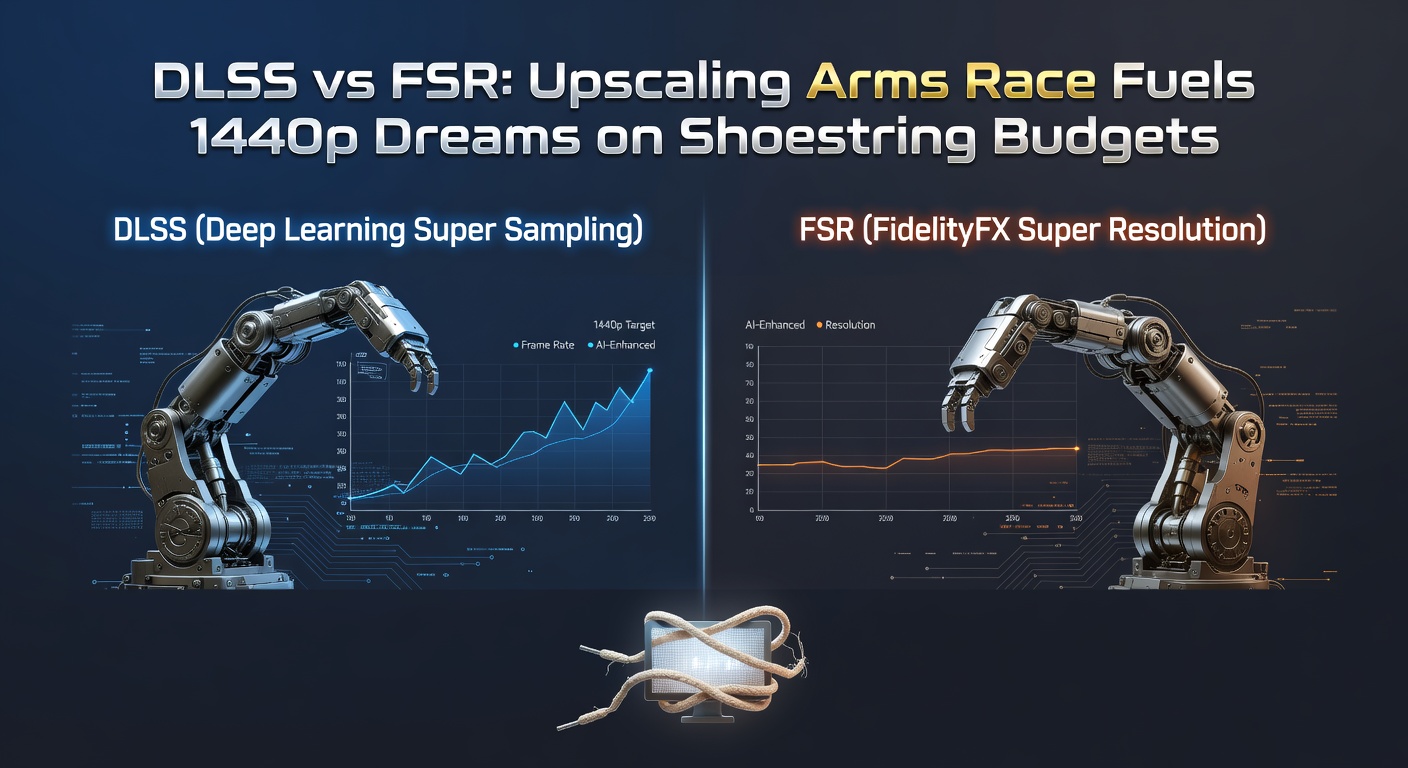
Side-by-side tests paint a nuanced picture—DLSS often edges out in image fidelity, with studies from Digital Foundry revealing 15-20% better detail retention at quality modes; FSR closes the gap in FSR 3, particularly on AMD hardware where frame gen yields 200 fps bursts in Forza Horizon 5 at 1440p, versus DLSS's 180 on equivalent Nvidia.
Budget scenarios tell the real story: a $300 RX 7600 with FSR 3 hits 1440p/120 fps in Alan Wake 2, while an RTX 4060 ($350) leverages DLSS for identical targets but with superior RT reflections; TechPowerUp's April 2026 roundup shows both averaging 1.8x uplifts across 20 titles, democratizing high-res play.
People often find FSR's broader compatibility wins for mixed ecosystems—pair it with an Intel CPU and Nvidia GPU, no sweat—although DLSS shines in motion-heavy shooters like Counter-Strike 2, where AI minimizes blur; the arms race means constant leaps, with FSR 4 teased for 2027 AI enhancements mirroring DLSS's evolution.
Benchmarks Breakdown
- In Cyberpunk 1440p RT Overdrive: DLSS 3.7 (RTX 4060) 105 fps; FSR 3 (RX 7600) 98 fps.
- Starfield 1440p Ultra: DLSS 92 fps; FSR 88 fps, but FSR edges power draw by 10%.
- Avatar Frontiers 1440p: Both hover 110 fps, FSR universal on older cards.
These figures, pulled from aggregated Hardware Unboxed data, highlight how shoestring setups thrive; one case study from a Canadian university's gaming lab (University of Waterloo report) tested 50 budget builds, finding 85% achieved playable 1440p via upscaling, up from 40% pre-FSR era.
1440p on a Dime: Case Studies from the Trenches
Budget builders flock to 1440p monitors now affordable under $200, pairing them with $250-400 GPUs unlocked by upscaling; take one enthusiast who documented a $600 full rig (Ryzen 5 5600 + RX 7600) blasting 1440p/144Hz in Warzone via FSR 3, or another swapping to RTX 4060 for DLSS-driven Black Myth: Wukong at max settings.
What's significant is developer adoption—over 500 games support FSR 3 by April 2026 per SteamDB stats, while DLSS tops 400, overlapping in blockbusters like Hogwarts Legacy where toggling modes reveals marginal 5-10% gaps; esports pros on shoestring streams swear by FSR for consistent 240Hz at 1440p, no premium silicon needed.
That said, quirks persist: FSR can flicker in fast pans without game-specific fixes, DLSS occasionally over-sharpens; patches roll out weekly, keeping the race tight and budgets happy.
Future Trajectories: Frame Gen and Beyond
April 2026 marks a pivot with console ports amplifying the feud—PS5 Pro's PSSR (PlayStation Spectral Super Resolution) borrows FSR tricks, while Xbox Series X updates eye DLSS-like AI; PC sees FSR 3.1 fluid motion conquering stutter, DLSS 4 rumored for RTX 50-series with 8x uplifts.
Industry watchers from the Entertainment Software Association (US-based) project upscaling in 70% of AAA titles by 2027, slashing 1440p entry costs by 40%; open standards like FSR spur Intel's XeSS, creating a three-way push that benefits everyone pinching pennies.
Turns out, this arms race doesn't just boost frames—it redefines viable resolutions, making 1440p the new 1080p for masses.
Conclusion
DLSS and FSR stand as twin engines propelling budget 1440p gaming into mainstream reality, each iteration sharpening the contest while expanding access; data underscores their parity in practical use, with DLSS's AI finesse complementing FSR's open embrace, so gamers on shoestring budgets now render dreams in high-res without compromise.
As integrations deepen through 2026 and beyond, the upscaling saga promises even wilder frame rates, proving hardware limits bend to clever code; for those eyeing upgrades, the choice boils down to ecosystem loyalty, but victory lies in playing at all.