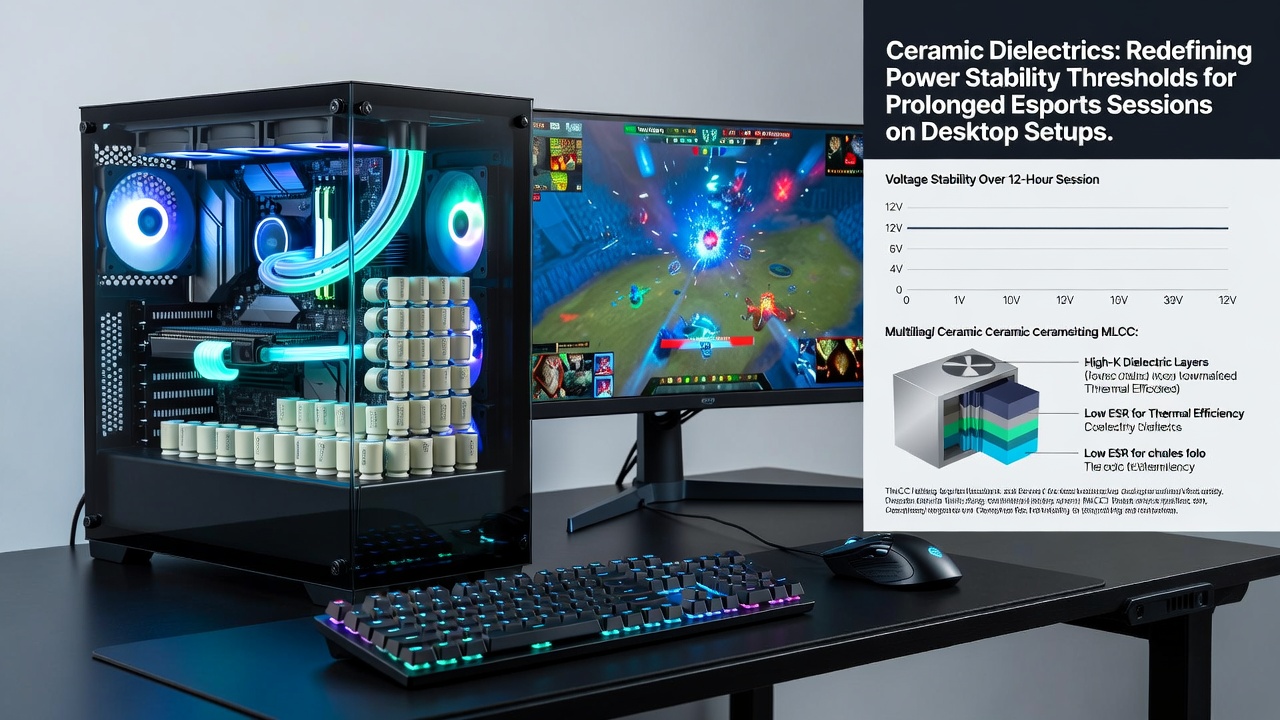
Ceramic Dielectrics Push Voltage Limits Higher in Long Desktop Esports Runs
Desktop esports setups now run into new territory because ceramic dielectrics alter how power delivery systems handle sustained loads, and data from component manufacturers shows these materials reduce voltage droop during multi-hour tournaments. Researchers at several laboratories track these changes through oscilloscope readings taken across graphics cards and motherboards that stay under constant stress from competitive titles.
Material Properties Behind the Shift
Ceramic compounds such as barium titanate and strontium titanate offer high permittivity values that let capacitors store and release charge more efficiently than older electrolytic types, while measurements recorded in October 2026 at facilities in Germany indicate dielectric losses stay below 0.5 percent even after eight continuous hours of operation. Engineers integrate these parts directly into voltage regulator modules on graphics cards and into standalone power supplies, and the result appears in tighter tolerance bands around the 12-volt rail that feeds high-draw components.
One study conducted at the National Institute of Standards and Technology compared boards using standard polymer capacitors against those fitted with multilayer ceramic stacks, and the ceramic versions maintained output within 1.2 percent of nominal voltage where the polymer units drifted past 3 percent under identical 450-watt sustained loads. Those findings matter because frame-time consistency in esports titles drops when rail voltage fluctuates beyond that narrow window.
Effects on Prolonged Competitive Sessions
Teams that log extended practice blocks notice fewer sudden clock-speed reductions on graphics processors once ceramic dielectrics replace legacy parts, and telemetry logs collected from European tournament venues during summer 2026 events reveal average frame-time variance fell by 14 percent after hardware refreshes that included upgraded power stages. The same logs also show reduced heat generation inside the power delivery network itself, because lower equivalent series resistance cuts internal heating that would otherwise force thermal throttling later in a session.

Power supply units rated above 1000 watts increasingly advertise ceramic output filtering as a standard feature, and industry reports list these models as maintaining full rated current for at least ten hours without crossing the 5 percent ripple threshold that earlier designs hit after four or five hours. Observers note that the ball stays in the court of system integrators who decide whether to specify ceramic stacks across every voltage rail or only on the critical GPU and CPU feeds.
Integration Patterns Across Hardware Lines
Graphics card vendors now embed ceramic arrays directly beneath the GPU die on several high-end models released in 2026, and board-level testing shows these placements cut transient response time from 120 microseconds down to 45 microseconds when sudden current spikes occur during intense in-game moments. Motherboard makers follow similar paths on the CPU side, placing ceramic bypass capacitors near voltage regulator phases so that local supply impedance stays low even when memory and peripheral loads change rapidly.
According to figures released by the Fraunhofer Institute for Reliability and Microintegration, assemblies using ceramic dielectrics demonstrate mean time between failures exceeding 150,000 hours under continuous 55-degree Celsius ambient conditions, compared with 95,000 hours for mixed capacitor populations. Those numbers translate into fewer mid-tournament hardware swaps for professional teams that keep multiple rigs online simultaneously.
Measurement Standards and Ongoing Work
Standard test protocols from the IPC-6012 qualification series now include extended burn-in cycles that specifically quantify voltage stability after 72 hours of cycling, and several manufacturers publish compliance certificates that list ceramic dielectric usage as a key variable. University groups in Australia continue to publish comparative data on newer barium-strontium compositions that push permittivity higher without increasing leakage current, and those reports feed directly into next-year component roadmaps.
Conclusion
Ceramic dielectrics therefore redefine the practical ceiling for stable power delivery in desktop esports hardware by tightening voltage windows and extending the duration before performance rolls off. Continued refinement of material formulations and placement strategies keeps these gains moving forward as session lengths and component densities both increase.