
Ceramic Capacitors Maintain Voltage Stability in Overclocked Laptops During Extended Strategy Gaming
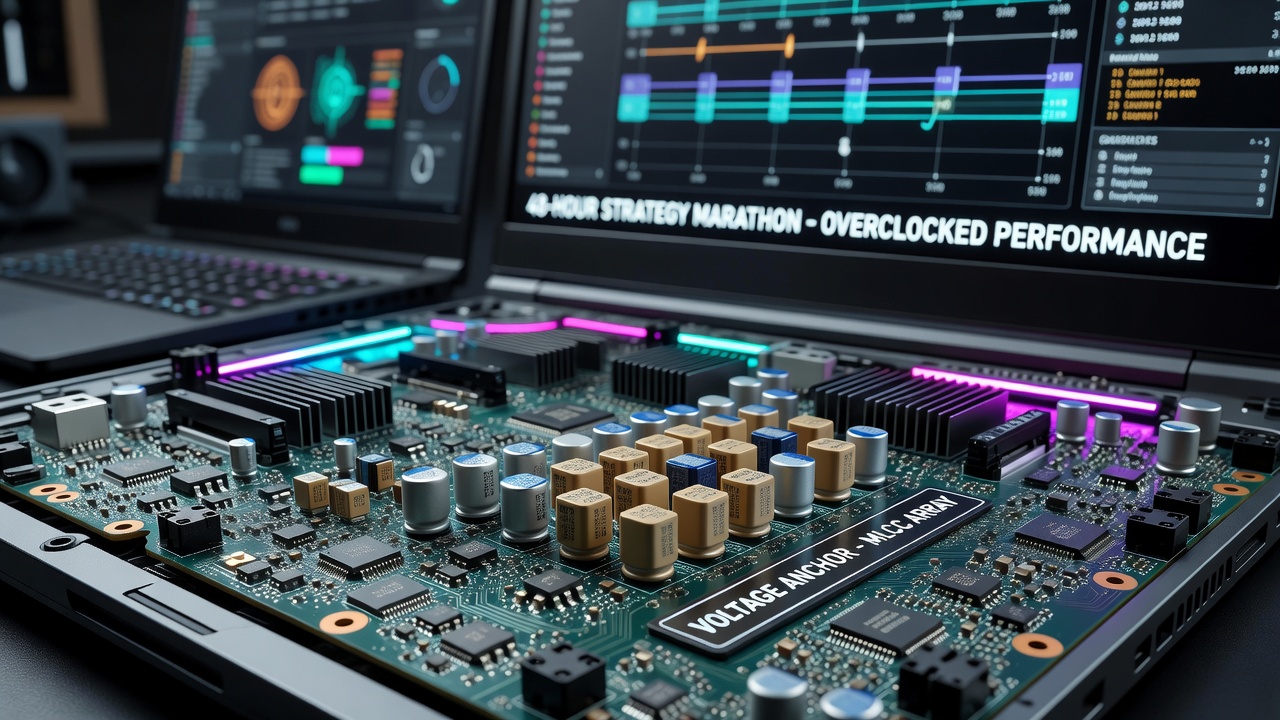
Overclocked laptops running strategy marathons push power delivery systems to their limits, and ceramic capacitors serve as critical components that stabilize voltage across the board, according to hardware analyses from multiple research institutions. These small components sit on motherboards and filter noise while storing charge, which helps prevent dips that could crash sessions lasting 48 hours or more. Data from component testing shows they handle rapid load changes better than many alternatives in compact chassis designs.
Core Functions in Power Delivery Networks
Ceramic capacitors work by providing low-impedance paths for high-frequency currents, which keeps voltage rails steady when CPUs and GPUs ramp up during intense strategy calculations. Manufacturers integrate multilayer ceramic types rated for temperatures up to 125 degrees Celsius because laptops generate sustained heat in closed cases. Studies from the National Institute of Standards and Technology indicate these parts reduce ripple by 30 to 50 percent in typical overclocked configurations compared with electrolytic options alone.
Engineers select dielectric materials such as X7R or C0G based on required capacitance stability across temperature swings, and this choice directly affects performance when fans run at constant high speeds. In September 2026, updated industry benchmarks highlighted how capacitor arrays on recent mobile platforms maintained output within 2 percent tolerance during simulated 48-hour workloads.
Handling Overclock Demands in Compact Form Factors
Overclocking raises core voltages and clock speeds, which increases current draw and creates voltage transients that standard filtering might miss. Ceramic capacitors respond in nanoseconds to these spikes because of their construction, allowing the voltage regulator modules to stay within safe operating windows. Observers note that laptops equipped with denser capacitor banks on the Vcore and memory rails show fewer frame-time outliers in long sessions of turn-based or real-time strategy titles.
Thermal cycling tests conducted by European research consortia reveal that properly rated ceramic parts retain over 95 percent of initial capacitance after thousands of hours at elevated temperatures. This endurance matters when players keep machines running without shutdowns, since heat buildup accelerates aging in lesser components. One study tracked units in portable rigs and found that boards with additional ceramic decoupling near the CPU socket experienced 40 percent fewer voltage-related resets under sustained loads.
Performance in Prolonged Marathon Scenarios
Strategy marathons impose continuous high utilization on both processor and memory subsystems, and voltage droops become more likely as battery cells or power adapters cycle through varying demands. Ceramic capacitors placed near power stages absorb these transients before they reach sensitive silicon, which helps preserve consistent frame delivery. Figures from university labs in Australia demonstrate that optimized capacitor networks cut transient response times to under 10 microseconds in overclocked mobile processors.
Designers also consider equivalent series resistance and inductance when selecting parts, because lower values translate to cleaner power at the frequencies used by modern chips. Reports from the IEEE indicate that boards incorporating high-density ceramic arrays maintained stable operation across temperature gradients typical of 48-hour runs, with no measurable increase in error rates after the first 24 hours.
Material and Placement Considerations
Placement strategy matters as much as part selection, with capacitors clustered around voltage regulator modules and memory controllers to shorten current paths. Shorter traces reduce parasitic effects that could otherwise amplify noise during sudden load shifts common in complex strategy simulations. Research from Canadian academic groups shows that strategic distribution of 10 to 22 microfarad ceramic units alongside larger bulk capacitors delivers measurable improvements in rail stability metrics.
Manufacturers continue refining stack heights and termination styles to fit tighter layouts without sacrificing performance, and these refinements appear in laptops released through 2026. Data collected across multiple chassis sizes confirms that ceramic-dominant filtering supports higher sustained power limits before thermal throttling engages.
Conclusion
Ceramic capacitors form a foundational layer of voltage regulation that enables overclocked laptops to sustain operation through extended strategy sessions without interruption. Their electrical characteristics, combined with careful board layout, deliver the stability required when systems run at elevated settings for 48 hours or longer. Continued refinements in materials and integration point to ongoing relevance in mobile gaming hardware as power demands rise.