Alloy Choices in Inductor Cores Reduce Ripple Effects in Portable VR Headsets for Marathon Multiplayer Events
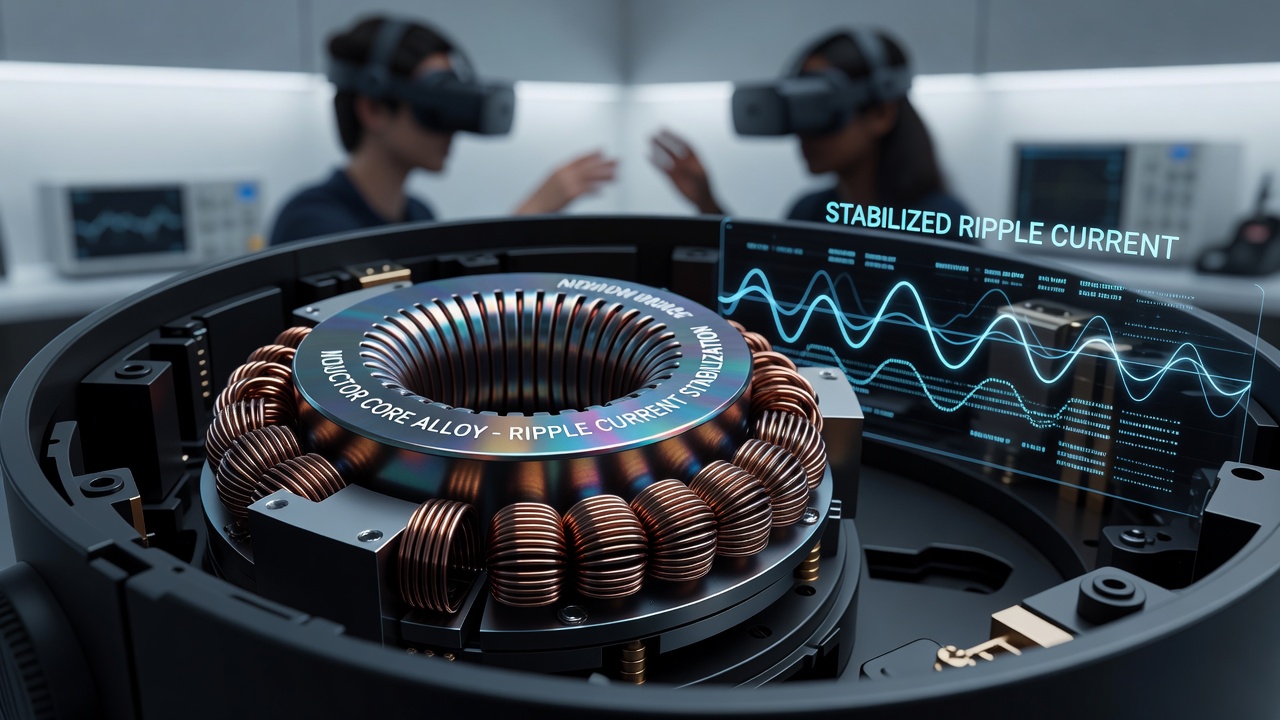
Portable VR headsets draw fluctuating loads during extended multiplayer sessions because graphics rendering, wireless data streams, and sensor arrays activate in rapid succession, and these demands create ripple currents that travel through onboard power converters. Inductor components sit at the heart of those converters where core materials determine how effectively ripple gets suppressed before it reaches sensitive display drivers and tracking chips.
Understanding Ripple Currents in Compact VR Systems
Ripple currents appear as small alternating components superimposed on the direct current supplied to processors and displays, and they grow larger when switching frequencies climb to support high-resolution rendering at 90 frames per second or more. Engineers measure ripple amplitude in millivolts or milliamps because values above certain thresholds produce visible artifacts on OLED panels and introduce jitter in positional tracking data.
Portable headsets operate from battery packs that deliver voltages between 3.7 and 11.1 volts, yet internal rails often require 1.0 to 1.8 volts at currents exceeding 8 amperes during peak multiplayer scenes. Buck converters handle the step-down task while inductors store and release energy each switching cycle, and the core alloy directly influences both storage capacity and energy loss.
Material Properties of Inductor Core Alloys
Manufacturers select alloys such as iron-silicon, sendust, and nanocrystalline compositions because each offers a distinct balance of permeability, saturation flux density, and core loss characteristics. Iron-silicon alloys provide high saturation levels above 1.5 tesla, which suits compact inductors that must handle transient spikes without entering saturation, whereas sendust materials reduce magnetostriction and therefore lower audible noise during high-frequency operation.
Nanocrystalline cores exhibit permeability values exceeding 10,000 while maintaining low losses up to several hundred kilohertz, and these traits allow designers to shrink inductor footprints without increasing temperature rise. Data from component testing laboratories show that swapping a standard ferrite core for a nanocrystalline equivalent can cut ripple voltage by 25 to 40 percent under identical load profiles.
Integration Challenges in Portable Headset Designs
Space constraints inside headsets force engineers to position inductors near heat-generating GPUs and wireless modules, so thermal conductivity of the core alloy becomes another selection criterion. Some alloys incorporate distributed air gaps that prevent flux crowding and keep inductance stable across wide current ranges, which proves useful when players switch between exploration modes and intense combat sequences.
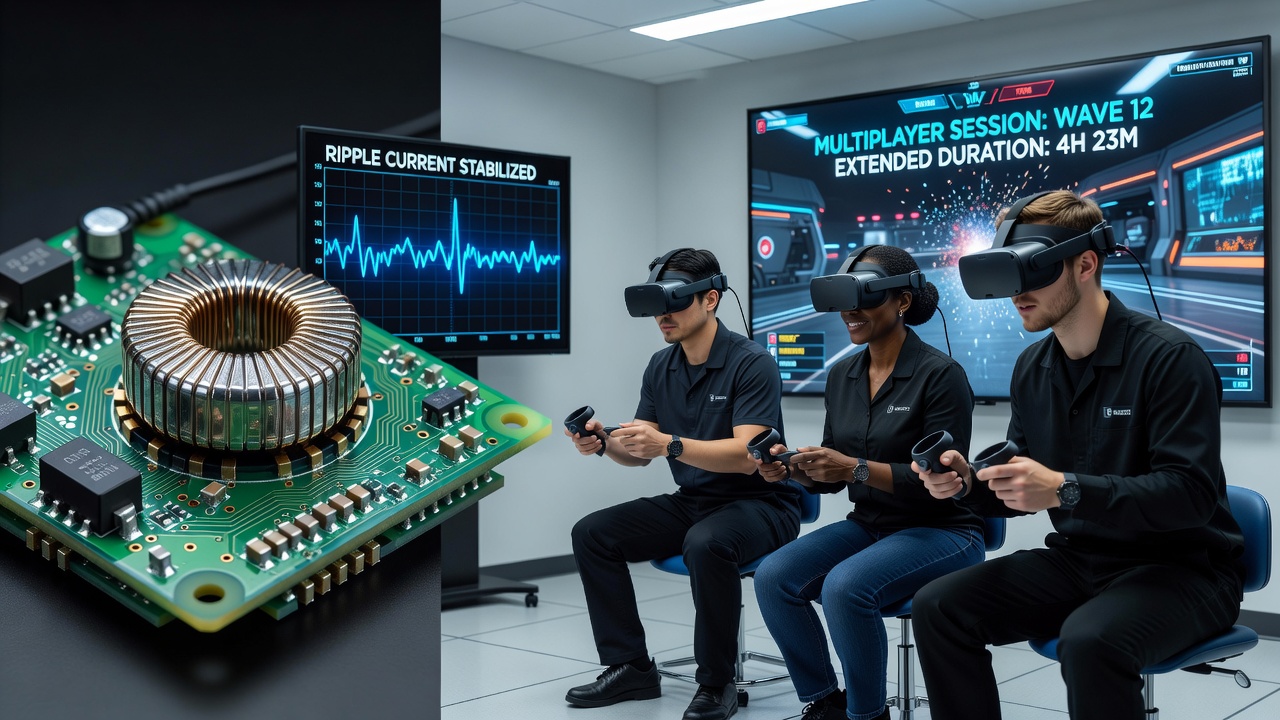
Manufacturers embed temperature sensors directly on inductor packages so firmware can throttle switching frequencies if core losses climb, and this feedback loop extends runtime without letting ripple exceed acceptable limits. In June 2026 several hardware platforms introduced revised power boards that pair nanocrystalline inductors with gallium-nitride switches, achieving measured ripple reductions of 32 percent during four-hour multiplayer benchmarks.
Performance Data from Extended Session Testing
Independent laboratories have recorded ripple behavior across sessions lasting six hours or longer, and results indicate that alloy choice correlates strongly with frame-time consistency. One study conducted at a North American research facility tracked voltage ripple on the display rail and found that heads using high-performance alloys maintained ripple below 18 millivolts throughout the test window, while standard cores exceeded 45 millivolts after three hours of continuous play.
European industry groups have published guidelines that recommend maximum ripple thresholds for virtual reality equipment, and compliance testing now includes temperature cycling to simulate repeated charge-discharge cycles typical of tournament environments. Observers note that headsets meeting these guidelines display fewer tracking drift events during prolonged group sessions.
Supply Chain and Manufacturing Trends
Production volumes for specialized core alloys have risen as demand for wireless VR hardware expands, and suppliers in Asia and North America have introduced automated pressing lines that achieve tighter tolerance on gap dimensions. These improvements reduce unit-to-unit variation in inductance values, which in turn simplifies calibration routines inside headset firmware.
Academic papers from institutions in Australia and Canada have examined the interaction between core alloy microstructure and high-frequency skin effect, revealing that certain grain orientations lower eddy current losses by up to 15 percent. Component vendors incorporate these findings into new powder formulations that appear in headsets released after mid-2026.
Conclusion
Inductor core alloys continue to shape the electrical stability of portable VR platforms by managing ripple currents that arise during extended multiplayer use, and ongoing refinements in material science and converter design support longer sessions without compromising visual or tracking performance. Data collected across multiple regions demonstrate measurable benefits when advanced alloys replace conventional core materials in compact power architectures.